Culturally Sustaining Literacy Instruction
Process
Learning Design Philosophy
For far too long, we have been limited in what our idea of learning is. The word “learning” invokes a four-walled room with neat rows of desks, with an instructor pouring knowledge into empty vessels. This enclosed view of learning and education is not designed to build knowledge beyond that room. True knowledge and learning is sparked when experiences and cultural sustenance are valued. Learners come into a space, digital or in person, with an immense amount of ideas and contributions to make. As learning designers, it is our responsibility to light the spark that enhances what someone already knows.
Connection and Culture
I believe the instructional design process must:
- Value the learners identity.
- Have connection between facilitator and student.
- Be relevant to the learner
- Be relevant to where and how the learner will apply their knowledge.
- Authentic tasks and opportunities to practice in varied modalities.
Curriculum Creation
The model used in creating this project was the 4C/ID system or Four Component Insutrctional Design. The complex process of teaching someone to identify culturally sustainable texts required learning task with supportive information and authentic tasks (van Merriënboer et al., 2002).
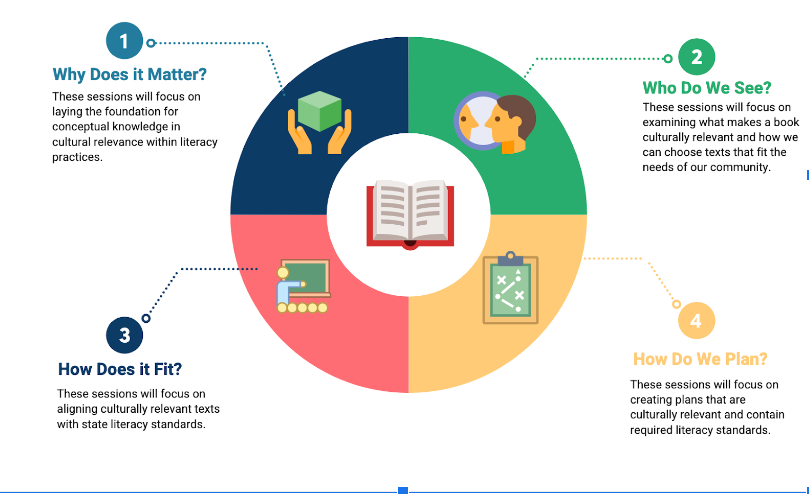
The first step in design was identifying what challenges educators would face. This step involved analyzing these questions:
- Why does this work matter?
- What does research say about culturally relevant literacy?
- How will teachers apply this in their real world classrooms?
To answer these questions, I spoke with educators, read blogs and studied research on teacher attitudes and perceptions of what culturally responsive pedagogy meant.
Next, came the research phase of looking for and analyzing data around culturally responsive teaching in early literacy classrooms. This step involved analyzing these questions:
- What are the benefits of culturally responsive literacy instruction?
- What is the current state of culturally responsive literacy instruction?
- What do curriculums currently offer or not offer educators?
This step involved academic research, and an analysis curriculums most often used by schools.
After completing these steps, the 4C model allowed for the collection and creation of learning tasks that would authentically represent what teachers needed in order to apply culturally relevant pedagogy. Then, procedural information was key in breaking down the task of choosing a book for their group of students. Finally, practice activities were created to gauge the learning.
The most challenging part of creating such a complex task is ensuring that each individual educator feels seen, and that they leave with feelings of empowerment. This challenge is also the most essential, as communities have different needs and perspectives.
The refinement of this curriculum project will involve a variety of educators and students. Their feedback and experiences will shape how learning units are edited and brought forth. The goal is that within the next 2 years, a full development with all units integrated will be available for teachers in an online platform.
References
van Merriënboer, J. J. G., Clark, R. E., & de Croock, M. B. M. (2002). Blueprints for Complex
Learning: The 4C/ID-Model. Educational Technology Research and Development, 50(2),
39–64. https://doi.org/10.1007/bf02504993
Abstract
This curriculum design project addresses the need for educators to select culturally sustaining literature for young learners. Evidence suggests a lack of diverse representation in educational materials, hindering students' cultural understanding and engagement. The purpose is to equip teachers with strategies for integrating inclusive literature into their classrooms. Drawing from socio-cultural theory, the curriculum emphasizes understanding diverse perspectives and promoting inclusivity. Teachers will engage in activities that will ask them to evaluate and choose texts for their community of learners, and then create lessons using Common Core literacy standards. Learning outcomes include the ability to use cultural frameworks to evaluate texts, while stating the importance and relevance of culturally sustaining pedagogy. Summative assessment methods will gauge participants' ability to select and integrate culturally relevant literature effectively. Implementation online modules to support teacher professional development. Evaluation includes pre- and post-assessment data, as well as participant feedback. Ultimately, this curriculum aims to empower educators to create more inclusive and enriching learning environments.
Overview of Units